Toimii paremmin sovelluksessa
2 ilmaista renderöintiä omasta autostasi — täysi laatu, ei kulmamerkkiä.
How Much Does It Cost to Wrap a Car?
Realistic ranges, what actually moves the price, and the one free step worth taking before any quote: seeing the colour on your own car.
The short answer: a professional full wrap on a standard car with quality film typically runs in the $2,500–$5,000 range in the US; partial wraps (roof, hood, mirrors) run in the low hundreds each; DIY full-wrap material starts at a few hundred dollars plus a steep learning curve. Exact pricing is always per-car and per-film — treat these as orientation, not a quote.
Typical costs at a glance
| Job | Typical range (US) | Worth knowing |
|---|---|---|
| Full wrap, sedan/hatch | $2,500–5,000 | Quality cast film, professional install |
| Full wrap, SUV/truck/van | $3,500–6,500+ | More surface, more labour |
| Colour-shift / chrome / specialty film | adds 30–100% | Film cost and fussier installation |
| Roof, hood or trunk only | $150–600 each | Popular first step; big look change |
| Mirrors, trim, accents | $50–200 | Cheap way to test a two-tone look |
| DIY full-wrap material | $300–1,500 | 50–75 ft of 60″ film + tools; expect waste on a first attempt |
| Wrap removal | $300–900 | Aged or baked-on film costs more to strip |
What actually moves the price
- Film grade. Premium cast vinyl conforms to curves, holds colour for years and removes cleanly; economy calendared film is cheaper per foot and shows it — on complex panels, at the edges, and in lifespan.
- Bodywork complexity. Deep bumper contours, roof rails, and door handles each add install time. Two cars of the same size can be hours apart in labour.
- Surface condition. Vinyl telegraphs chips, dents and rust rather than hiding them — and adhesive can pull failing clear-coat off on removal. Prep is part of an honest quote.
- Edges and de-trimming. Shops that remove lights and trim to tuck edges charge more than shops that wrap to the edge — and the result lasts correspondingly longer.
The cheapest step in the whole project
Every cost above is committed the moment the film goes on — a colour you regret costs the full price twice. Which is why the highest-value step is also the free one: see the colour on your actual car first. Upload a photo to the wrap visualizer, try the candidate colours in gloss, satin and matte, and take the render to the shop as the brief. Bodywork only — glass, trim, wheels and background stay exactly as photographed, so what you're judging is the colour, not an artist's impression.
More free car tools
Frequently asked questions
- How much does a full car wrap cost professionally?
- For a standard sedan with quality cast vinyl and professional installation, most quotes land in the low-to-mid four figures — commonly somewhere between about $2,500 and $5,000 in the US, with the middle of that range typical. Larger vehicles, premium or colour-shift films, and complex bodywork push it higher; simple shapes and promotional-grade film can come in under it. Always get a written quote for your exact car and film.
- Why do wrap quotes vary so much between shops?
- Four honest reasons: film grade (premium cast vinyl costs several times what economy calendared film does, and lasts accordingly), vehicle complexity (deep curves, door handles, and bumper shapes multiply labour), prep work (a wrap telegraphs every chip and dent underneath, so honest shops budget time to address the surface), and whether the shop de-trims panels or wraps around edges. A quote far below the local market usually means economy film or edges that will lift.
- How much does it cost to wrap a car yourself?
- Material for a full sedan wrap is roughly 50 to 75 feet of 60-inch film — typically a few hundred dollars in economy film, up to four figures for premium brands — plus tools (squeegees, heat gun, knifeless tape). The honest caveat: first-time full wraps rarely come out clean, and wasted film adds up fast. A hood, roof, or mirrors are realistic first DIY projects; a full body wrap on your first attempt usually isn't.
- Is wrapping cheaper than painting?
- Against a comparable-quality respray, usually yes — a quality full respray in a new colour often costs as much as or more than a premium wrap, because paint requires disassembly, booth time and cure time. The comparison flips at the low end: a budget paint job can undercut a quality wrap. The wrap's structural advantages are reversibility (lease-safe, resale-safe) and that it protects the factory paint underneath.
- How long does a wrap last?
- Quality cast vinyl professionally installed and reasonably cared for typically lasts around five to seven years; economy film and harsh sun shorten that considerably. Vertical surfaces age better than horizontal ones (hood and roof take the most UV). Hand-washing extends life; pressure washers at close range and automatic brushes end it early.
- Can I see a wrap color on my own car before paying for it?
- Yes — upload a photo of your car to the free wrap visualizer, pick a colour and finish (gloss, satin, matte, metallic), and it recolours the bodywork only: glass, trim, wheels and background stay untouched. Rendering two or three candidate colours on your own car is the cheapest mistake-prevention available, given that changing your mind after installation costs the full price again.
See the wrap before you pay for it
Upload your car photo, pick a colour and finish — the render keeps everything except the bodywork untouched. Free, in your browser.
Try wrap colors on my car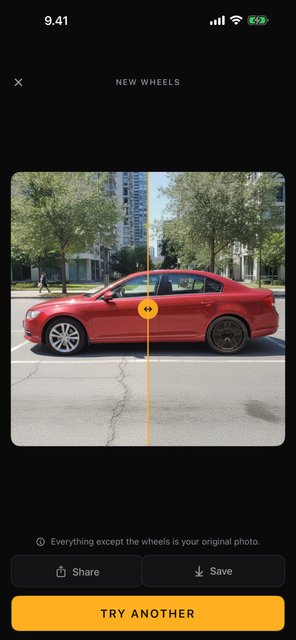
Ilmainen sovellus · Android & iPhone
Car Mods AI: Wheels & Wraps
Vanteet, teippaukset, tummennukset ja vannevärit omaan autokuvaasi — autosi pysyy täsmälleen autonasi. Kamerasta renderöintiin sekunneissa, ja aloitat 2 ilmaisella renderöinnillä — täysi laatu, ei kulmamerkkiä.
| Sovelluksessa | Android | iPhone |
|---|---|---|
| Vanteenvaihto — mikä tahansa malli | Kyllä | Kyllä |
| Teippaus & maaliväri | Kyllä | Kyllä |
| Taustamaisemat | Kyllä | Kyllä |
| Ikkunoiden tummennus | Kyllä | Kyllä |
| Vanteiden väri | Kyllä | Kyllä |
| Rekisterikilven sumennus | Kyllä | tulossa |